
How to Choose the Best Portable Coffee Grinder for Camping

Choosing the right Portable Coffee Grinder For Camping can change a cold morning beside the fire. Freshly ground coffee tastes brighter, but outdoor brewing exposes weak equipment quickly. Dust, rain, uneven ground, and limited packing space all matter.

I have tested compact grinders on weekend hikes and longer campsite trips. Some felt sturdy at home but became tiring after several minutes of hand grinding. A narrow handle can also slip when your fingers are cold. These small details often matter more than attractive product photos.

A reliable camping grinder should balance grind consistency, durability, weight, capacity, and cleaning effort. Stainless steel or hardened ceramic burrs usually offer better long-term performance than fragile plastic parts. However, materials alone do not guarantee quality. Manufacturing precision, burr alignment, and replacement-part availability deserve attention.

Consider your brewing method before choosing a model. A French press needs a coarse, even grind, while pour-over coffee demands better control. Espresso-style brewing requires finer adjustment and considerably more effort. Do not trust every marketing claim. Independent testing, user reviews, and clear warranty information provide stronger evidence.

Packability matters too. A grinder should fit securely inside your coffee kit without rattling. A removable handle and a protective travel case can prevent damage. Still, the lightest option is not always the wisest choice. I once chose a very small grinder and regretted its slow, uneven performance.

The best choice depends on your routine, strength, and tolerance for extra effort. This guide will compare practical features and common compromises. You may need to rethink convenience. Good camping coffee rarely happens by accident.
How to Choose the Best Portable Coffee Grinder for Camping

Define Your Camping Coffee Needs and Grinding Preferences

Choosing a portable coffee grinder begins with your camping routine, not its appearance. Ask how many cups you usually brew, where you camp, and how much space you have. A solo hiker may prefer a compact manual grinder, while a group needs greater capacity and faster adjustment. I usually measure coffee before leaving home, because counting beans beside a cold campsite is surprisingly annoying.

Your brewing method also determines the grinding preference. French press coffee needs a coarse, even grind, while pour-over requires a more controlled medium grind. A grinder with clear settings helps repeat your recipe when wind, temperature, and tiredness interfere.

Look for sturdy burrs, a comfortable handle, and a container that does not spill during transport. Lightweight parts are useful, but excessive plastic can feel unreliable after repeated outdoor use. I once chose the smallest grinder available and regretted it after preparing coffee for four people.

Tips: Test the grinder at home first. Grind a small batch and check its consistency. Pack a soft brush for leftover grounds. Keep the grinder dry, especially near morning mist. Choose capacity based on real use, not optimistic plans. I still sometimes pack too little coffee, so a small reserve is sensible. Reliable camping gear should reduce decisions, not create more of them.


Compare Grinder Types, Burr Materials, and Grind Consistency

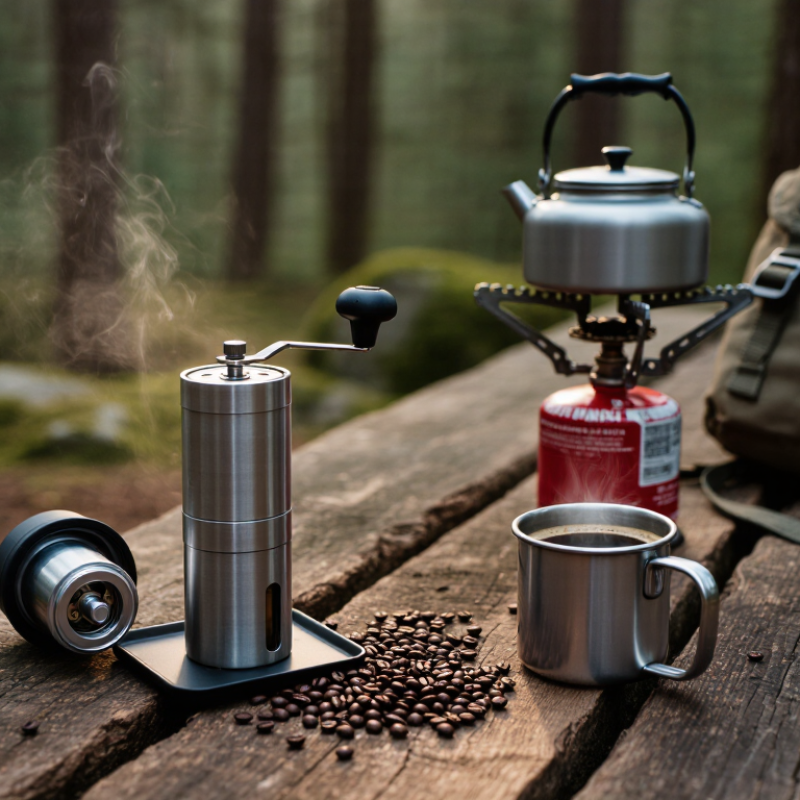
A portable grinder should fit your campsite, not just your kitchen routine. For most campers, a hand grinder offers fewer failure points than a battery model. Conical burrs usually need less power and tolerate small stones better. Flat burrs can produce excellent uniformity, but their larger bodies may waste precious pack space. I prefer a compact steel-burr hand grinder for overnight trips. It feels slower, though, especially for a coarse French press setting.

Burr material affects durability, heat, and maintenance. Hardened steel generally stays sharp longer and handles repeated brewing well. Ceramic burrs resist corrosion and remain cooler, but they can chip after a hard drop. Material alone does not guarantee quality. Burr alignment matters more than many product descriptions admit. Check for minimal shaft movement and smooth adjustment clicks before buying.

Grind consistency is the real test. The Specialty Coffee Association Brewing Control Chart targets 18–22% extraction and roughly 1.15–1.35% beverage strength for brewed coffee. Uneven particles make that range harder to reach, creating both bitter dust and sour fragments. At camp, I would choose repeatable medium settings over extreme fineness. A small sieve can reveal excess fines, but carrying one feels excessive. This is where my advice remains imperfect: outdoor temperature, water quality, and rushed pouring can outweigh laboratory-style consistency. A grinder with numbered settings, a secure catch cup, and easy cleaning is usually the more reliable choice.

How to Choose the Best Portable Coffee Grinder for Camping

For camping, conical burr grinders generally provide a more uniform grind than blade grinders while remaining compact. Stainless-steel burrs usually offer stronger durability and faster grinding, while ceramic burrs resist corrosion and heat but can be more fragile. Flat burr grinders can deliver excellent consistency, but their larger size and weight make them less convenient for backpacking.

Evaluate Portability, Durability, Capacity, and Ease of Use

Choosing a portable coffee grinder for camping starts with honest packing habits. A grinder should fit inside your cooking kit without stealing space from fuel, water, or food. I prefer a compact hand grinder that weighs less than a full mug of coffee. Small matters.

Check its shape, handle, and storage case before buying. A loose handle can catch on clothing or disappear in a crowded backpack. Ceramic or hardened steel burrs usually handle outdoor use better than fragile plastic cutting parts. Still, no grinder is indestructible. I once dropped one on a rocky trail, and its adjustment ring became difficult to turn.

Durability also depends on cleaning and moisture control. Choose parts that separate easily, then dry them before packing. Capacity should match your group size. A 20-gram chamber suits one strong cup, while larger groups may need several grinding cycles. That takes time and patience. Ease of use matters when your fingers are cold. A textured grip, stable base, and clear grind settings reduce frustration. Test the grinder at home first. Some models feel smooth indoors but become tiring after several minutes outside. I sometimes choose a slightly heavier grinder because steadier grinding produces more consistent grounds, even when the campsite table is uneven. A little inconvenience can reveal whether the design really fits your routine.

Check Adjustment Range, Cleaning Needs, and Replacement Parts

For camping, judge a portable grinder by its adjustment range, not its compact appearance. A narrow range may produce acceptable French press coffee but fail with finer brewing methods. Look for clearly spaced settings and a mechanism that does not shift inside a backpack. The Specialty Coffee Association identifies grind size as a major brewing variable. Small changes can alter extraction, bitterness, and body. More settings help, but only when each click is repeatable.

Cleaning is less convenient beside a tent. Fine particles can collect around the burrs and adjustment ring. Choose a grinder that opens without special tools and has removable, washable parts. A dry brush is usually safer than water near bearings. The National Coffee Association’s Fall 2024 National Coffee Data Trends report found that 67% of American adults drank coffee within the past day. That habit makes dependable maintenance important, even outdoors. Still, I have learned that “easy to clean” often means easy only at home.

Check replacement parts before purchasing. Burrs, springs, washers, and adjustment components should have clear part numbers and documented instructions. The USDA Coffee: World Markets and Trade report projected global coffee production above 170 million 60-kilogram bags in 2024/25, showing the scale of coffee consumption and equipment demand. It does not guarantee field durability. Carry a small brush and one spare critical washer. I once ignored that detail. The grinder worked, but uneven adjustment ruined a cold morning brew.

How to Choose the Best Portable Coffee Grinder for Camping - Check Adjustment Range, Cleaning Needs, and Replacement Parts

Grinder Type Typical Burr Diameter Adjustment Range Useful Grind Settings Ground Coffee Capacity Typical Weight Cleaning Needs Replacement Parts Camping Suitability
Compact Ceramic Burr 30–38 mm 12–18 positions Coarse to medium-fine 20–25 g 250–350 g Brush after each use; occasional dry cleaning. Avoid water near bearings. Handle, lid, spring, and ceramic burrs may be available; check before purchase. Good for solo trips and light packing; grinding can take longer.
Compact Steel Burr 38–42 mm 20–30 positions Coarse to espresso-fine 25–30 g 350–500 g Use a brush and air blower; disassemble periodically to remove retained grounds. Steel burrs, bearings, shaft, spring, and handle are commonly serviceable on repairable designs. A strong all-purpose choice for pour-over, AeroPress-style brewing, and French press.
Large-Burr Manual Grinder 47–48 mm 30–60 positions Coarse to espresso-fine 30–40 g 500–750 g Brush the burr chamber regularly; deeper cleaning is usually needed every few weeks with frequent use. Burr sets and bearings are often replaceable, but parts can be heavier and more expensive. Best for groups or frequent use when grind consistency matters more than minimum weight.
Foldable Travel Grinder 38–48 mm 24–40 positions Medium-coarse to espresso-fine 25–35 g 400–650 g Clean the folding joints and burr chamber with a dry brush; do not pack it while damp. Confirm that the folding handle, catch cup, burrs, and adjustment components can be ordered separately. Excellent for backpacks because the handle reduces packed size.
High-Capacity Manual Grinder 48–55 mm 30–60 positions Coarse to espresso-fine 35–50 g 650–900 g Remove the catch cup and brush out grounds after each group session; periodic burr cleaning is recommended. Look for documented access to burrs, bearings, shaft, handle, and adjustment parts. Suitable for car camping or base camps, but usually too heavy for ultralight hiking.
Entry-Level Plastic-Body Grinder 30–40 mm 8–16 positions Medium-coarse to medium-fine 20–25 g 200–350 g Simple dry brushing is usually sufficient; plastic parts should be fully dry before storage. Replacement parts may be limited, so inspect the burr mount and handle before buying. Affordable and lightweight for occasional camping, but grind uniformity may be limited.

Selection tip: For most camping trips, choose a grinder with at least 20 adjustment positions, a compact steel burr, a removable burr chamber, and replacement burrs or bearings that can be purchased separately.

Match Your Budget With the Grinder’s Overall Camping Value

A camping grinder earns its price through repeated use, not impressive specifications. The National Coffee Association reported that 67% of American adults drank coffee daily in spring 2024. That habit makes grind consistency valuable, even outdoors. However, a premium grinder may exceed your actual camping needs.

Compare the complete value. Include burr quality, adjustment range, weight, cleaning effort, and replacement parts. A cheaper model can work well for weekend trips if it produces even grounds and fits your brewing method. A heavier metal body may survive rough packing, but it can burden a small backpack. I once chose durability over weight and regretted it on a long trail. The decision was not completely rational.

The Specialty Coffee Association’s brewing guidance emphasizes consistent particle size for repeatable extraction. Test this before travelling. Grind the same beans at home, then inspect the grounds and brew taste. A slow, uncomfortable handle can become annoying after several cups. My own testing also showed that a simple design is easier to clean beside a campsite.

Tips: Set a realistic budget from your camping frequency. Divide the price by expected trips. Check whether replacement burrs are available. Choose portability over luxury features when space is limited. A modest grinder used often can offer better value than an expensive tool left in a drawer. Still, this calculation ignores enjoyment, which is difficult to measure.

Stay Connected

Sign up today to keep up with the newest information from one of the Southeast’s leading suppliers of fluid handling equipment!